
Retail Media Radar - Cannes Lions 2026 edition: The Commerce Media Land Grab
The Croisette filled up last week, and so did the retail media news flow. Cannes Lions has become one of the places where the commerce media land grab shows itself most clearly. Beneath a record-breaking heatwave and the usual rosé-fuelled noise, three significant deals and one connecting theme told a single story: the industry is racing to collapse a fragmented retail media stack into something unified, measurable and increasingly autonomous. This edition cuts through the activation fluff to the moves that actually shift the market. Grab a coffee and dive in.
Asda brings Amazon's ad tech to UK grocery in a first-of-its-kind deal
Asda has become the first retailer anywhere outside the US to deploy Amazon Retail Ad Service, the cloud-based ad tech Amazon began offering to third-party retailers in early 2025. Rolling out in phases from Q4 2026 across Asda's online grocery and George.com platforms, it uses Amazon's machine learning, trained on real shopping behaviour and intent, to serve more relevant onsite sponsored ads. For suppliers, it means a simpler way to plan, run and measure campaigns through the Amazon Ads tools they already know, with consistent cross-platform reporting.
This is the first proof point that Amazon's “ad tech as a service” playbook, the same logic that built AWS and Supply Chain by Amazon, is exportable into the UK grocery sector. For mid-market grocers watching their own retail media economics, it sharpens the strategic question considerably: build your own stack, licence an independent platform, or hand the infrastructure to Amazon and accept the dependency that comes with it. Asda gets scale and a large brand demand pool quickly. The trade-off is ceding the underlying intelligence layer to a competitor. That tension is the one to watch in every grocer's boardroom this year, and exactly the build-versus-partner conversation we are having with clients.
Nectar360 puts hard numbers behind Pollen
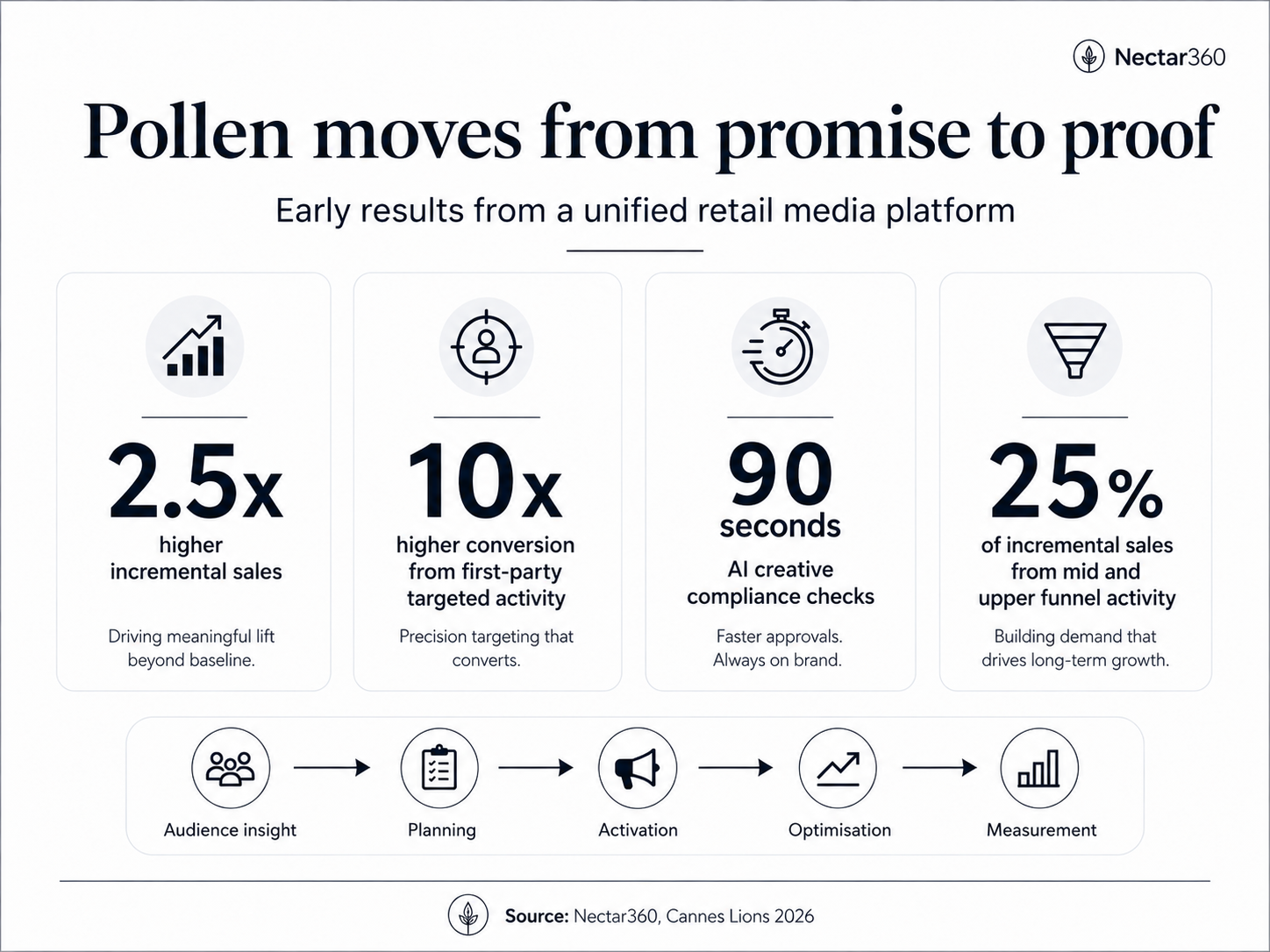
Sainsbury's loyalty arm Nectar360 used Cannes to move Pollen, its unified retail media platform, from launch promise to early evidence. A year on from its Cannes Lions 2025 debut, the reported figures are striking: over 2.5 times higher incremental sales from omnichannel campaigns, up to 10 times higher conversion from first-party-data-targeted activity, and an AI creative compliance checker that cuts checks from weeks down to roughly 90 seconds. Unilever and Coca-Cola Europacific Partners are named early adopters.
The most interesting claim is that up to 25% of incremental sales came from mid and upper-funnel activity. That directly challenges the lazy framing of retail media as a pure lower-funnel conversion channel, and supports the argument that retail media is now a genuine brand-building medium. The other signal is the platform thesis itself: Pollen is explicitly built to solve fragmentation by unifying audience insight, planning, activation, optimisation and measurement, with multi-touch attribution at its core. Fragmentation is the pain point brands keep naming. The competitive advantage is shifting towards platforms that can connect audience insight, activation and measurement without forcing brands through another disconnected workflow.
Walmart buys its way into mid-market CTV with Vibe.co
Walmart announced it will acquire Vibe.co, a self-serve connected TV ad platform pitched as the “Google Ads of streaming.” Terms were undisclosed, with the deal expected to close by the end of Walmart's FY2027. The logic: fold Vibe's self-serve CTV stack into Walmart Connect alongside VIZIO inventory and Walmart's first-party purchase data, opening streaming TV to the small and mid-sized advertisers (including Walmart's own marketplace sellers) who have historically found CTV too complex and too expensive to access.
Walmart Connect's ad business reached $6.4bn in FY2026, up 46%, so this is consolidation from a position of strength. The strategic thread is access: commerce media networks racing to make premium channels buyable by long-tail advertisers, with first-party retail data as the targeting and closed-loop measurement edge. Meta and Pinterest are circling the same small-business CTV prize, so expect more retail-media-meets-streaming M&A, and expect Cannes week to keep being the stage on which it lands.
Agentic commerce moves from slideware to pilots
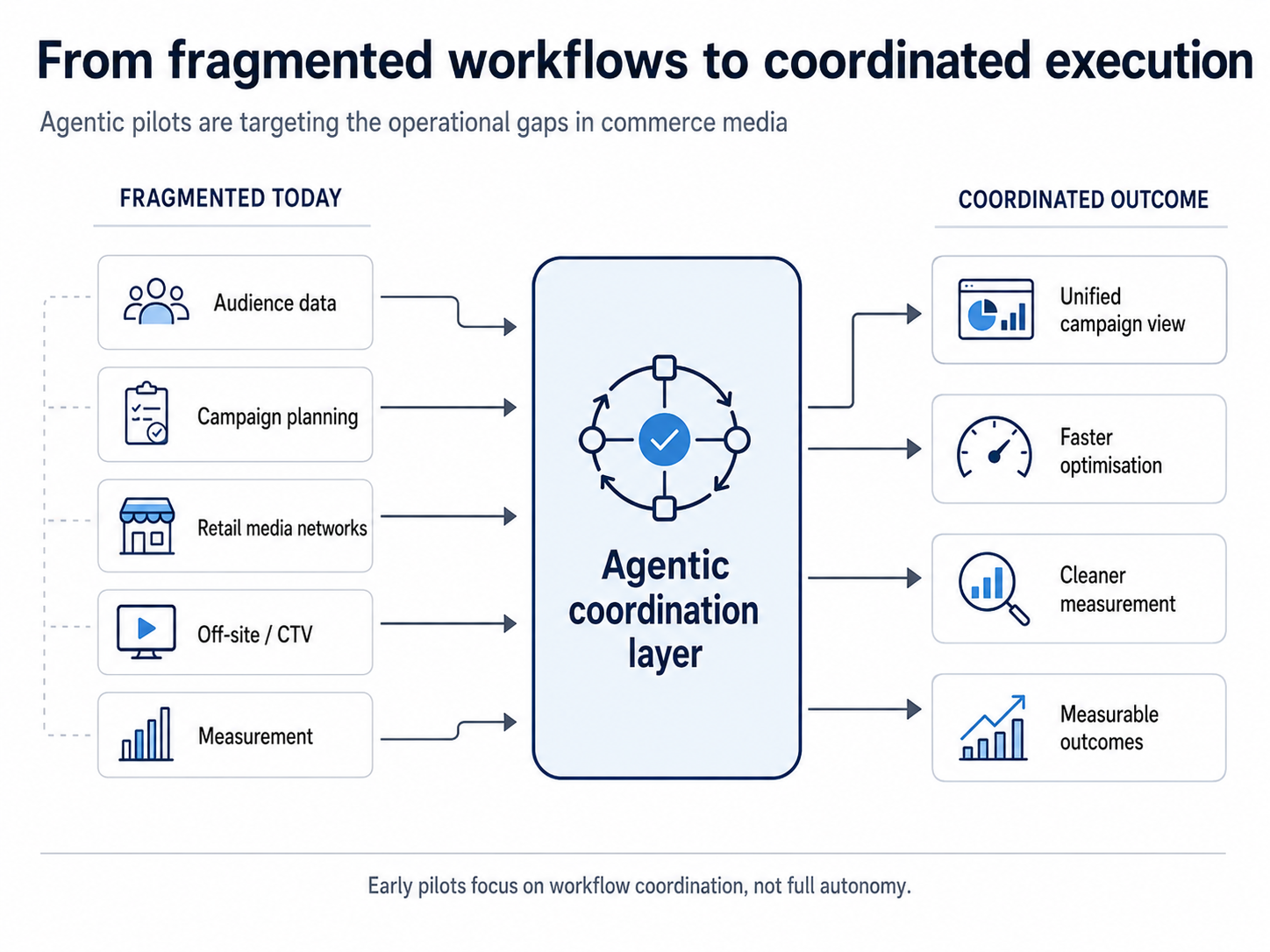
Across the wider ad tech announcements, the dominant theme was the shift from AI-assisted tools toward agentic systems that plan, coordinate and execute media decisions. The retail-relevant signals were clear. LiveRamp launched agentic AI pilots targeting three verticals specifically, food delivery, big-box retail and grocery commerce media, framed around fixing fragmented workflows and weak return-on-ad-spend visibility. Criteo passed 2,000 brands advertising via ChatGPT, an early read on large language models becoming genuine commerce ad surfaces. And the likes of Magnite and PubMatic pushed agent-to-agent infrastructure, with interoperability and human control as the reassurance message.
The honest caveat is that none of these announcements quantified how much of a campaign an agent actually runs end to end without a human. The word “pilot” should be read literally: constrained tests with named participants, not general release. The credible version of the agentic pitch targets the unglamorous coordination work in commerce media operations, reconciling disconnected systems and producing a clean view of what worked, rather than creative generation. That is precisely the fragmentation problem the Asda, Nectar360 and Walmart stories are each attacking from a different angle.
Three deals, one direction of travel. Whether through Amazon's exported ad tech, Nectar360's in-house unified platform, or Walmart's acquisition route, the prize being contested is the same: a single, measurable, first-party-data-powered environment that removes the fragmentation brands keep complaining about. For mid-market grocery and FMCG retailers, the build-versus-licence-versus-partner decision just got more urgent, and the cost of getting the data ownership question wrong got higher. Agentic capability is the layer everyone is racing toward, but the gap between announcement and verified deployment remains wide. As Nectar360 framed its own Cannes theme: proof, not hype.
If that is a conversation worth having for your business, let's talk.