
For most of its short life, retail media has been built one retailer at a time. Each network had its own platform, its own sales team and its own way of counting results. In September, Kiri Masters of Retail Media Breakfast Club compared the networks to toddlers in parallel play: sitting side by side, not sharing.
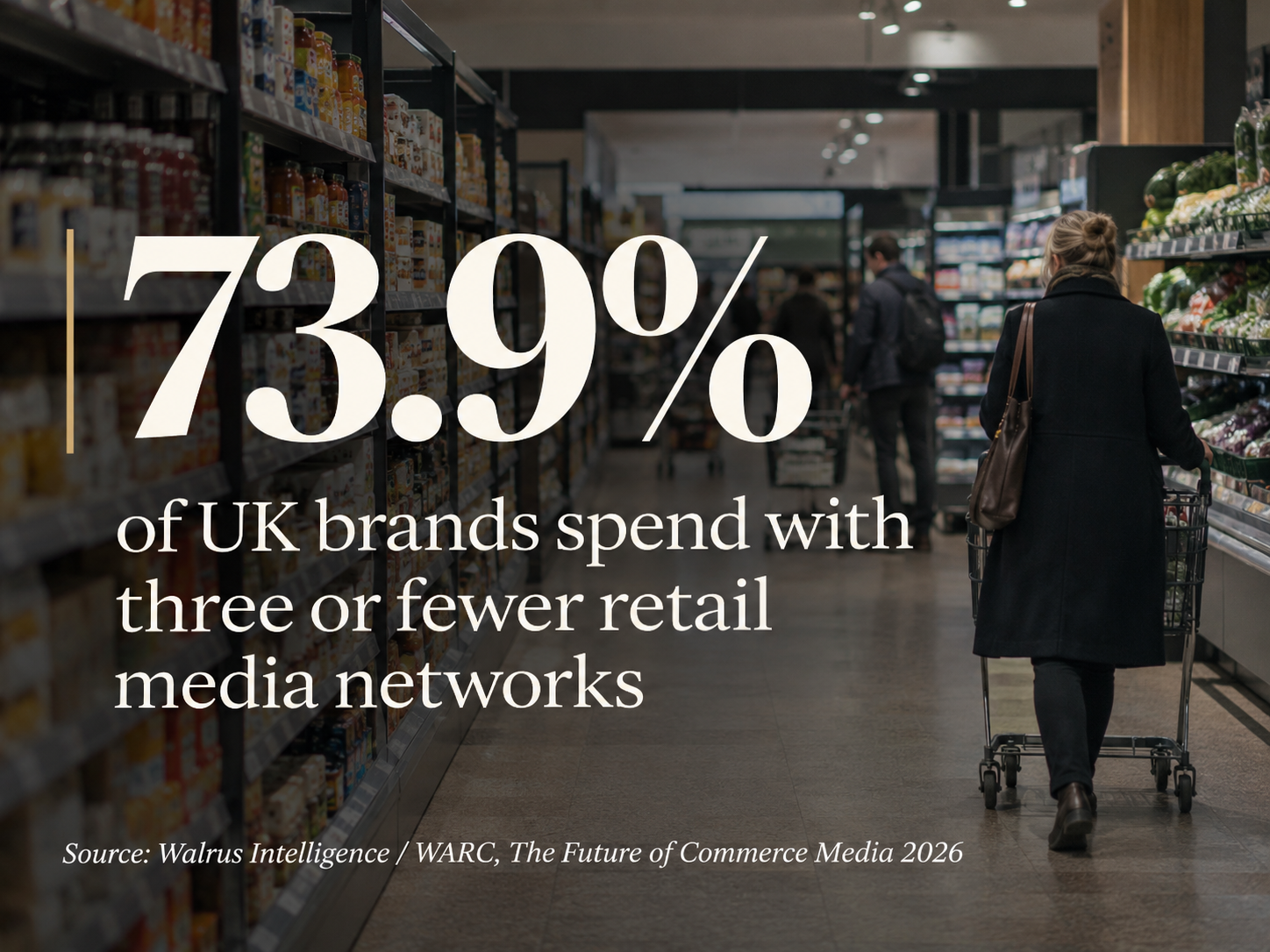
That is starting to change, and brands are a big part of the reason. FMCG (fast-moving consumer goods) advertisers don’t have the budget or the people to run campaigns with every retailer that has launched a network, so they are settling on a short list. Analysis published by WARC this summer found that nearly three-quarters of UK brands spend with three or fewer networks. A retailer outside that list has a problem, and more of them are deciding the answer is to team up.
This month we start with the evidence that brands are narrowing down, then look at how retailers are responding. In the US, Gopuff has handed its on-site ad technology to Instacart, Best Buy is working with Amazon on Fire TV, and DoorDash has agreed to buy Instacart for about $17 billion. In Europe, Coopérative U is joining a sales network part-owned by a rival, and two UK platforms are testing ways to buy across several retailers at once.
Brands are working from a short list
The clearest number comes from analysis by Walrus Intelligence, published in WARC Media’s Future of Commerce Media 2026 report in August. It found that 73.9% of UK brands spend with three or fewer retail media networks. The same report says that none of the UK’s eight largest domestic networks earns as much as a third of its revenue from the smaller half of its advertisers. Most of the money comes from a few big brands, and those brands are choosing carefully.
The reason is workload as much as budget. Every network comes with its own platform, buying process, audience definitions and way of measuring results. “Managing hundreds of ‘mini walled gardens’ is operationally unsustainable,” wrote Claire Trbovic, global head of product at SMG, in InternetRetailing in May. Advertisers, she said, are “consolidating spend across a smaller number of larger partners”. SMG has something to sell here, as we’ll come to, but agencies are saying much the same. Jason Colon, who leads the commerce media practice at Horizon Commerce, told a New York audience in September that the next stage will be less about launching networks and more about working out which ones are worth buying, The Drum reported.
The argument is being made on the other side of the world too. Writing in Mumbrella on 2 October, Mark Ritson predicted that “within three years Australian buyers will settle on two, maybe three networks”. A marketer short of budget and time, he wrote, “will pick two and quietly stop answering emails from the others”.
Why it matters: a network outside a brand’s short list gets what is left of the budget, if anything. Having loyal shoppers and a good loyalty scheme doesn’t earn a place on its own.
UK advertisers have now put the inconsistency on record. A study by ISBA, the advertisers’ trade body, and mediasense, published on 8 September and funded by ten advertisers, assessed five of the UK’s largest networks on more than 200 points. It found that retailers define core measures differently, including what counts as a sale driven by an ad, and that no single retailer combines all the leading practices. Rob Edwards, head of media and digital at Arla Foods UK, said that “brands need clarity and consistency to make data-led decisions”.
The retailers that make the list are being kept for longer. IAB Europe’s Attitudes to Retail Media 2026 report, published on 3 November, found that 71% of European buyers have worked with their retail partners for more than a year, up from 51% in 2024.
What earns a place is proof. In the same survey, 61% of buyers named a lack of measurement and reporting as a leading barrier to spending more. Only 49% now ask for return on ad spend (the sales generated for each pound of advertising), down from 89% last year. More of them want reporting that joins up online and in-store sales (66%) and incrementality, meaning sales that wouldn’t have happened without the ad (57%).
So brands are spending with a handful of retailers, staying with them for longer and asking harder questions. For a mid-sized retailer that leaves two ways onto the list. One is to prove results as well as the biggest networks can. The other is to become easier to buy by joining forces with someone else, and that second route is what the rest of this issue is about.
Find out more about the WARC figures here, read Claire Trbovic’s article here, The Drum’s report here, Mark Ritson’s column here, the ISBA study here, and the IAB Europe report here.
DoorDash agrees to buy Instacart as US networks share their technology
In September, Instacart and Gopuff announced that Gopuff would join the Instacart Marketplace and use Carrot Ads, Instacart’s white-label ad technology (built by one company and run by others under their own name), on its own storefront. Instacart’s 9,000-plus advertisers can extend their campaigns to Gopuff’s customers, some of whom get their order in as little as 15 minutes. Michael Peroutka, Gopuff’s head of ads, was frank about the reasoning when he spoke to The Drum in October. “I’m a realist,” he said. “I understand where we kind of sit on the food chain, and we do need to fight for every dollar.”
Around the same time, Best Buy expanded its Fire TV deal with Amazon. Best Buy Ads can sell ad space on Insignia TVs that run Fire TV, and from February 2027 it will use Amazon Ads’ programmatic technology, the software that buys and sells ad space automatically.
Then, on 29 October, DoorDash agreed to buy Instacart in a deal worth about $17 billion, or $65 a share, with at least 75% paid in cash. It needs clearance from regulators in the US, Canada and Israel and is expected to close at the end of 2027 or in the first half of 2028. Instacart’s advertising and other revenue was $331 million in the third quarter, up 23% on a year earlier.
Why it matters: more than 310 retailers and partners run their advertising on Carrot Ads. If the deal completes, that technology will belong to a delivery company that competes with many of them for grocery orders. They will want to know what happens to their data, their pricing and their place in the queue for new features.
Auxbow co-founder Kristina Kaganer argues in AdExchanger that this is mainly an advertising purchase: “Both companies have billion-dollar ad businesses. Only one of them is an ad business.” She also points to the gap in Instacart’s offer. Its ads prove sales on Instacart, while most grocery shopping still happens in stores. In her words, advertisers “pay for the basket, not the proof”.
Brands aren’t sure yet whether it helps them. Erik Joergens-Kokate of Mars Snacking, quoted by Kiri Masters, said: “I think consolidation could benefit the challenger brands, but less clear for established brands.”
Sharing also creates more than one route to the same shopper. Brands can reach Gopuff customers directly or through Instacart, and Fire TV viewers through Best Buy Ads or Amazon Ads. Having fewer places to buy doesn’t guarantee a clearer picture of who saw what.
Completion is more than a year away, so Carrot Ads partners have time to ask those questions and should use it. Brands can spend the same time working out where they already reach the same shopper by two routes, and how that overlap is counted.
Find out more here, read Kristina Kaganer’s column here, Gopuff’s reasoning here, Kiri Masters on who wins here, and Digiday’s case for and against consolidation here.
Europe’s retailers start pooling their reach
Coopérative U, the French grocery co-operative with around 2,000 stores, will hand the sale of its digital advertising space to Unlimitail from January 2027 under a multi-year deal. Unlimitail is the retail media joint venture set up by Carrefour and Publicis, so Coopérative U is giving its ad sales to a business part-owned by a direct competitor. The announcement puts the combined network at nearly 35% of the French grocery market. That is Unlimitail’s own figure.
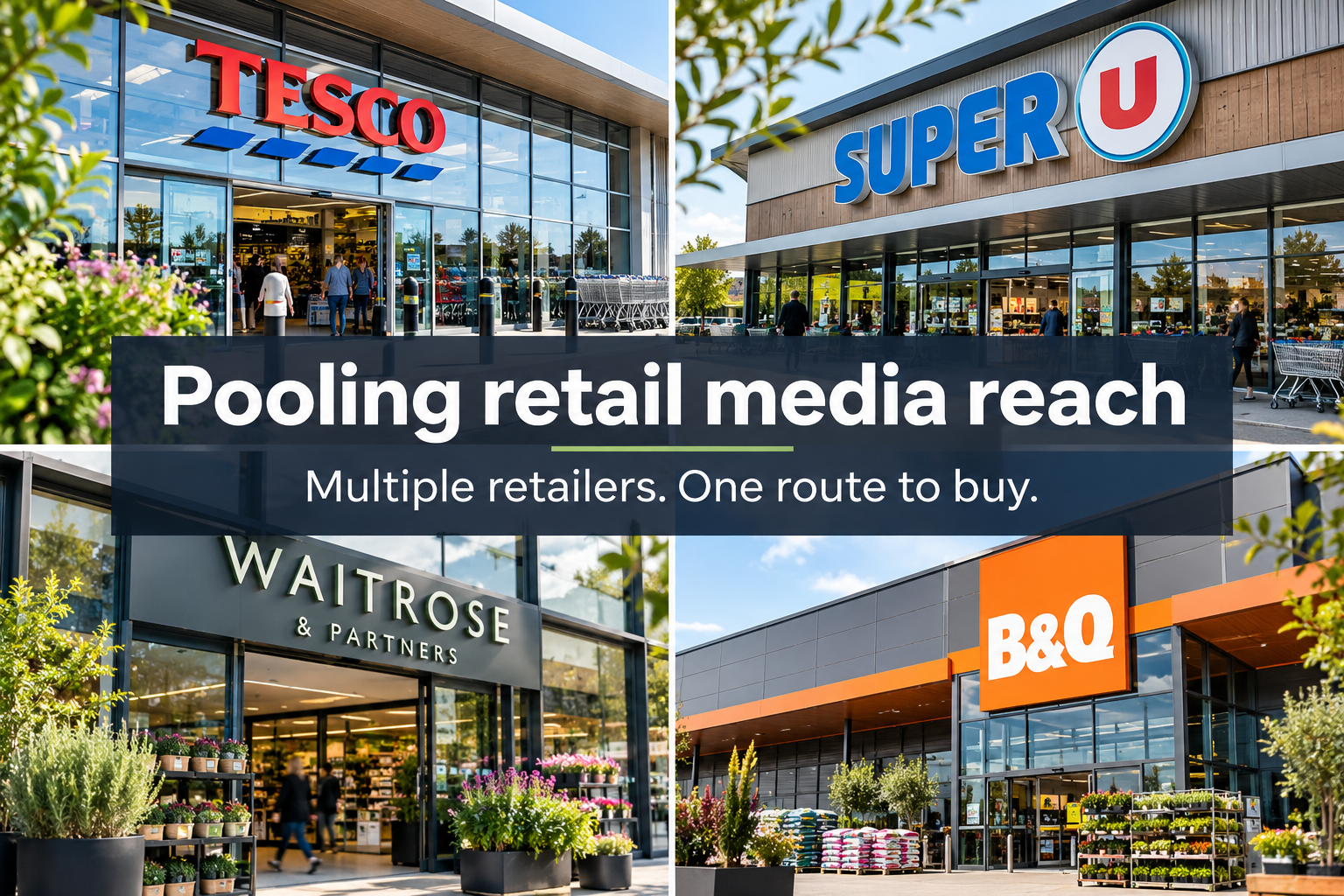
The UK is testing a looser version of the same idea. The dunnhumby network alliance, announced in June, is piloting a single route for brands to plan and buy campaigns across Tesco, B&Q, John Lewis and Waitrose, with each retailer keeping control of its own ad business. “Brands are demanding scale, consistency and transparency, but fragmentation has held the market back,” said dunnhumby’s chief executive, Josh Bottomley, at the launch. Separately, SMG has started a beta (an early test version) of RMX, an exchange for finding, booking and reporting on campaigns across several networks, with Omnicom Media as its first agency partner. It starts with in-store screens in the UK, and no retailers have been named yet. This is the single way in that Claire Trbovic argued for in May. As she put it: “An exchange model isn’t a silver bullet, but it is a credible path forward.”
Why it matters: this is a direct answer to the short list. One brief, one booking and one report covering several retailers is easier for a brand to justify than yet another separate relationship.
The models differ in how much a retailer gives up. Coopérative U is handing over its digital ad sales altogether. The dunnhumby alliance and RMX leave each retailer in charge of its own inventory and commercial terms.
Shared measurement is the hard part. dunnhumby promises common standards for running, measuring and reporting campaigns, but hasn’t yet said how results will be compared from one retailer to the next. ISBA’s study asks for the same thing from the advertisers’ side: a shared glossary, common reporting principles and more openness about buying tiers.
Pooling gives smaller retailers a chance at budgets they would struggle to win alone. The cost is some control over pricing, data and their own relationships with brands. For advertisers, a single route to buy only helps if the results from each retailer can be compared too.
Find out more here, read about the dunnhumby network alliance here, and RMX here.
Trust is the price of collaboration: the Federal Trade Commission’s (FTC) case against Amazon’s ad auction
On 5 November, the FTC and 22 US states published an unredacted version of their complaint against Amazon’s advertising business, first filed in August. They allege that Amazon secretly raised the prices advertisers paid by up to 50% above the auction result on ordinary days and up to 250% on Prime Day and Black Friday. The complaint says the surcharges added $87 million of revenue in the 2022 holiday season, and that in 2023 the head of Amazon Ads suggested using reserves to find extra revenue: “ideally at least $40MM would be helpful.”
Why it matters: advertisers need to understand how the price they pay is calculated. The complaint alleges that when advertisers questioned rising costs, Amazon attributed them to competition; one account manager reportedly said there was ‘not a bug, or a change in auction style’.
These are allegations in an ongoing case in a Washington federal court, and no ruling or trial date has been announced. Amazon has not been found liable.
The timing matters for every network. Walmart has moved display ads in Canada to an open auction, Tesco is launching self-serve buying, and brands are being asked to commit to longer partnerships. Each of those depends on advertisers believing the auction is run fairly.
The allegations put auction transparency firmly on the agenda. Advertisers will want clearer explanations of clearing prices, surcharges and the reporting available to check what they paid. Networks able to explain those mechanics plainly will be in a stronger position when negotiating longer commitments.
Find out more here.
Also on the radar
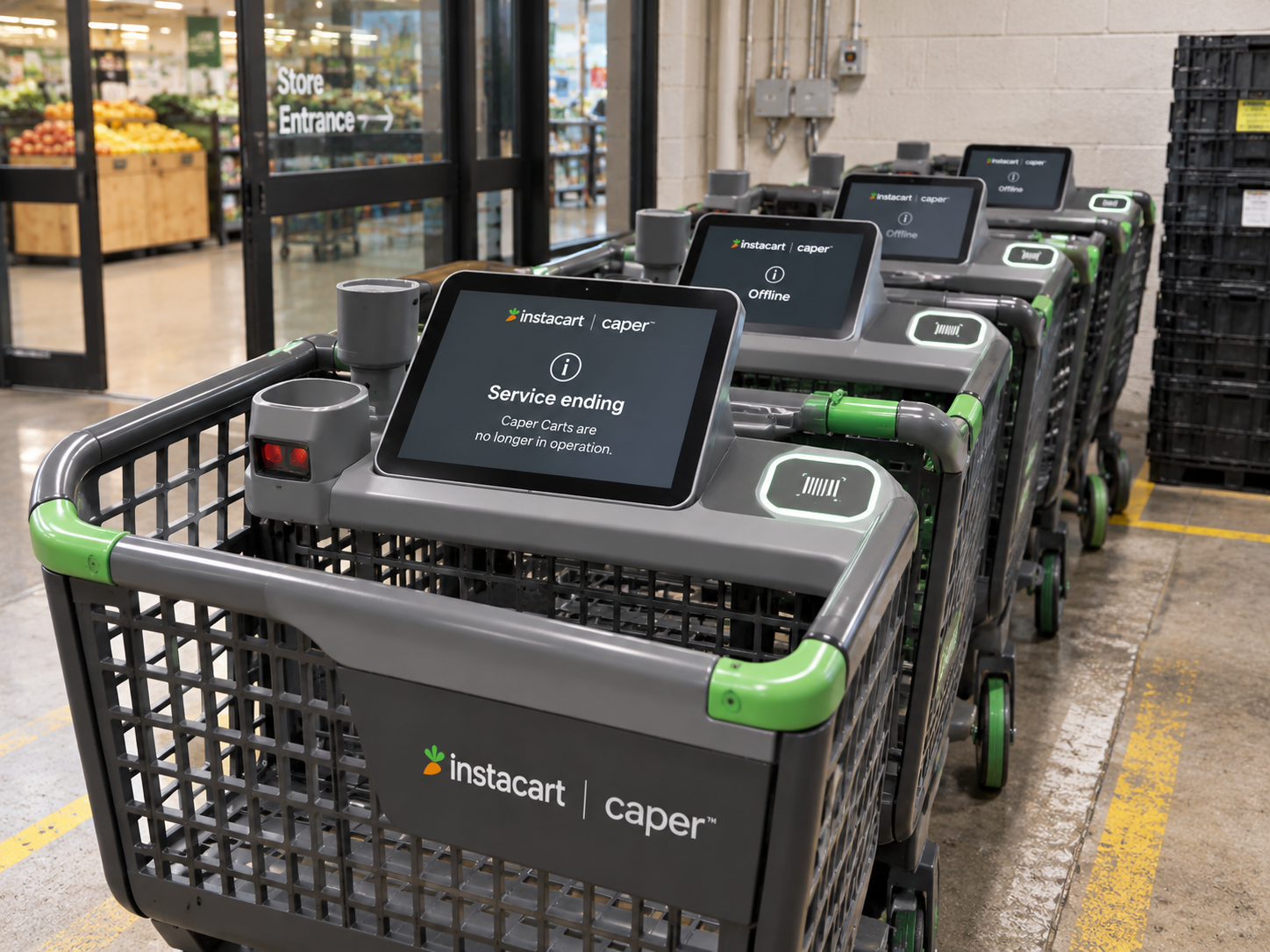
Instacart is shutting down its AI-powered smart shopping carts business, called Caper Carts, saying retailer adoption “has not scaled quickly enough to justify our continued investment.” It expects pre-tax losses of $55 million to $80 million and to finish by the end of the second quarter of 2027, and will focus on in-store software and data instead. The Morrisons trial in Preston that we covered in September’s Retail Media Radar has ended as a result. A smart trolley is only an ad channel if enough retailers put it in their stores.
Find out more here.
For a long time the talking point in retail media was how many networks there were. This month’s news suggests the number to watch is how few of them a brand will actually work with. Gopuff has decided it is better off inside Instacart’s sales effort than outside it, and Coopérative U has made the same call with Unlimitail. DoorDash has gone a step further and bought the technology.
Collaboration here doesn’t have to mean merging. Apart from DoorDash, nobody in this issue is buying anybody. The dunnhumby alliance and RMX are built so that each retailer keeps its own shoppers, data and commercial terms, while brands get one way in. What isn’t settled is measurement. Shared buying is arriving faster than shared reporting, and the ISBA and IAB Europe findings show which of the two brands care about more. Retailers weighing up a partnership should be clear about what they keep. Brands should ask whether one booking also brings one set of results they can trust.